LEAVE A COMMENT

December 31, 2013.

This blog is now closed. After three years and 311 posts, I have decided to end this blog. I have enjoyed watching the films, reviewing them, and interacting with global readers.

If you are interested in contacting me, you can do so by commenting on any of the posts. The blog will remain live on the web.
Thank you to all the readers for your comments, ideas, and thoughts. They were helpful, stimulating, and enriching. This is Alene, signing off.

September 28, 2011

Winter's Bone (2010)


When it's over, some of the images linger in my mind as a reminder of how some people are forced to live as well as how courage can take many forms.  Without giving away too much of the plot, some images that stayed with me are the swamp scene, the children jumping on the trampoline, the children learning to shoot a rifle, skinning the squirrel, and delivering the "goods" to the sheriff's office.  Winter's Bone doesn't follow the conventional story structure.  It doesn't have a beginning, middle, and end.  It's a snapshot of the middle spanning about a week's time frame. Newcomer Jennifer Lawrence gives a powerful performance as Ree, a 17 year old girl who must find her drug dealing father in time before the family home is taken away by the court.  Her search for answers lead her down a path of violence and brutality, and she must find a way to survive while caring for her two siblings as well as her unresponsive mother.  I found myself captivated by Ree's character and her unflinching courage to save and protect her family.  The film shows how much we can endure as individuals when our livelihood is threatened and the people we love are at risk of being torn away from us.  There's nothing glamourous or uplifting about this film.  It's bleak, depressing, and completely realistic in its depiction of the corrupt and poor living in rural Missouri. 

My rating: 4.5 out of 5

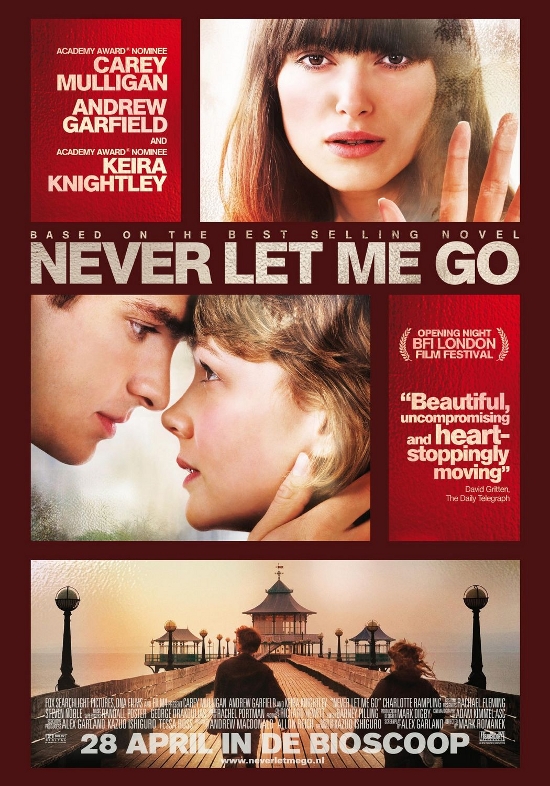
Never Let Me Go (2010)

When it's over, the first thing that comes to my mind is the word tragic.  The film is based on the book of the same title by Kazuo Ishigoru about three friends (Kathy, Tommy, and Ruth) who grow up together at an English boarding school where they learn they are clones developed for the sole purpose of being harvested for their organs.  The love shared between the three is strong and as they become young adults their love is put to the test as they await their fates to unfold.  The three characters were well crafted and were played beautifully and hauntingly by Carey Mulligan (Kathy), Andrew Garfield (Tommy), and Keira Knightly (Ruth).  Mulligan was especially brilliant as the main character who I thought really carried the film from beginning to end by conveying so much emotion without uttering a word.  Unlike other human cloning films, this film focused in on the love story between these three friends and how they chose to live their lives knowing their fates were not their own.  This film wasn't about rebellion, or running away, or about challenging a corporation, but rather, it was about emotions - the human emotions of regret, jealousy, love, forgiveness, loss, fear, redemption, and hope.  In the film, these characters were thought of as "things" to be used and disposed of.  However, as the viewer, we see the characters as so much more than lab rats.  We forget they are clones, because they become so real as we relate to their hopes, their sadnesses and their heartbreaks.  We grow to care for them as unique individuals, not clones, and that's where the tragedy lies, because what happens to them simply isn't fair or humane.  I think the film brings to surface some ethical issues worth discusssing as well such as: Are clones considered human?  If you knew your fate was death, how would you live your life?  Would you run?  Would you fight back?  Or would you want to live your life as normal as you could possibly make it for as long as you can? 

My rating: 4.5 out of 5

September 19, 2011

Drive Angry ( 2011)

When it's over, there's enough blood, severed limbs, and destruction to rival recent Quentin Tarantino films.  Without much of a story and a whole bunch of scenes stitched loosely together, Drive Angry would make most viewers walk out of a theatre demanding their money back.  Nicholas Cage disappoints as the father who escapes from Hell to avenge his daughter's death and to save his granddaughter from being sacrificed at the alter by a satanic cult.  In the mis-mash of explosions, bullets, and arterial splatter, I simply couldn't stay awake.  The violence was simply too over-excessive and gratuitous, and like anything that's been shoved in your face for too long, you simply become numb to it's effects. Cage still looks good; his car is still smoking; and he's got a really cool gun, but all this, isn't enough to carry a movie.  I would have liked to learn more about Cage's character, John Milton - how he ended up in Hell, and more interesting, how he managed to escape.  Also, the story never explains why Milton's daughter was the target and then her baby.  Is there a connection?  The film says "no," but maybe there should have been.  It would have tightened the plot and elevated the story to whole new level.

My rating: 1.5 out of 5


September 11, 2011

Limitless (2011)

When it's over, success should be defined by who you are and what you do, not what drug you are taking.  Bradley Cooper makes a dramatic turn in acting as Eddie Morra, a writer that has hit rock bottom, until a friend offers him an experimental drug which heightens the brain's ability to retain, store, and sort information.  The drug turns Eddie's life around and soon, he becomes dependant on it.  I thought the film was original, entertaining, and well thought out.  I liked the visual effects used to show what was going through the minds of people taking the drug.  It was all very psychedelic - very cool.  However, I didn't like the message the film was sending.  Rated at 14A, it sends the message, especially to young viewer, that taking drugs is okay and that in small controlled doses, you can use it to gain what you want, whether that be success or popularity.  The film glamorizes the use of drugs, and although it does explore the side effects of drugs and potential pitfalls, the film ultimately chose to be pro drug as illustrated by Eddie's decision to continue using it to stay on top of his game.  I think a more appropriate ending would be that he gets off the drug, and learns from his mistakes, and starts his life over, which can also be considered a life of success.

My rating: 3.5 out of 5


Sanctum (USA/Australia - 2010)


When it's over, there are no creatures, monsters, and abnormal humanoids in this film.  It's simply a film about man versus nature, and in this case, an extensive cave in Papua New Guinea.  When the members of a cave diving expedition suddenly find themselves trapped in the cave, they must rely on teamwork, wits, and courage to find a way out before the cave floods completely.  Even though the film was based on true events that happened in Australia in 1988, the film was still a work of fiction and therefore, there are a lot of theatrics in the some of the death scenes.  I won't say how many people die, but it's a given in a film like this that there are going to be casualties.  However, it's very interesting how they die.  Nobody dies the same way, which tells me that the director had chosen specific deaths for specific people, based on their personality.  The film was thrilling and by the end of it, I felt a renewed sense of respect for the people who actually do cave diving recreationally and professionally. The gear they tug, the knowledge required, the ability to make life and death decisions, and the mental control they must have are all so crucial in the success and survival of a diving expedition, and the film clearly illustrates all these points without holding anything back.


My rating: 3.5 out of 5